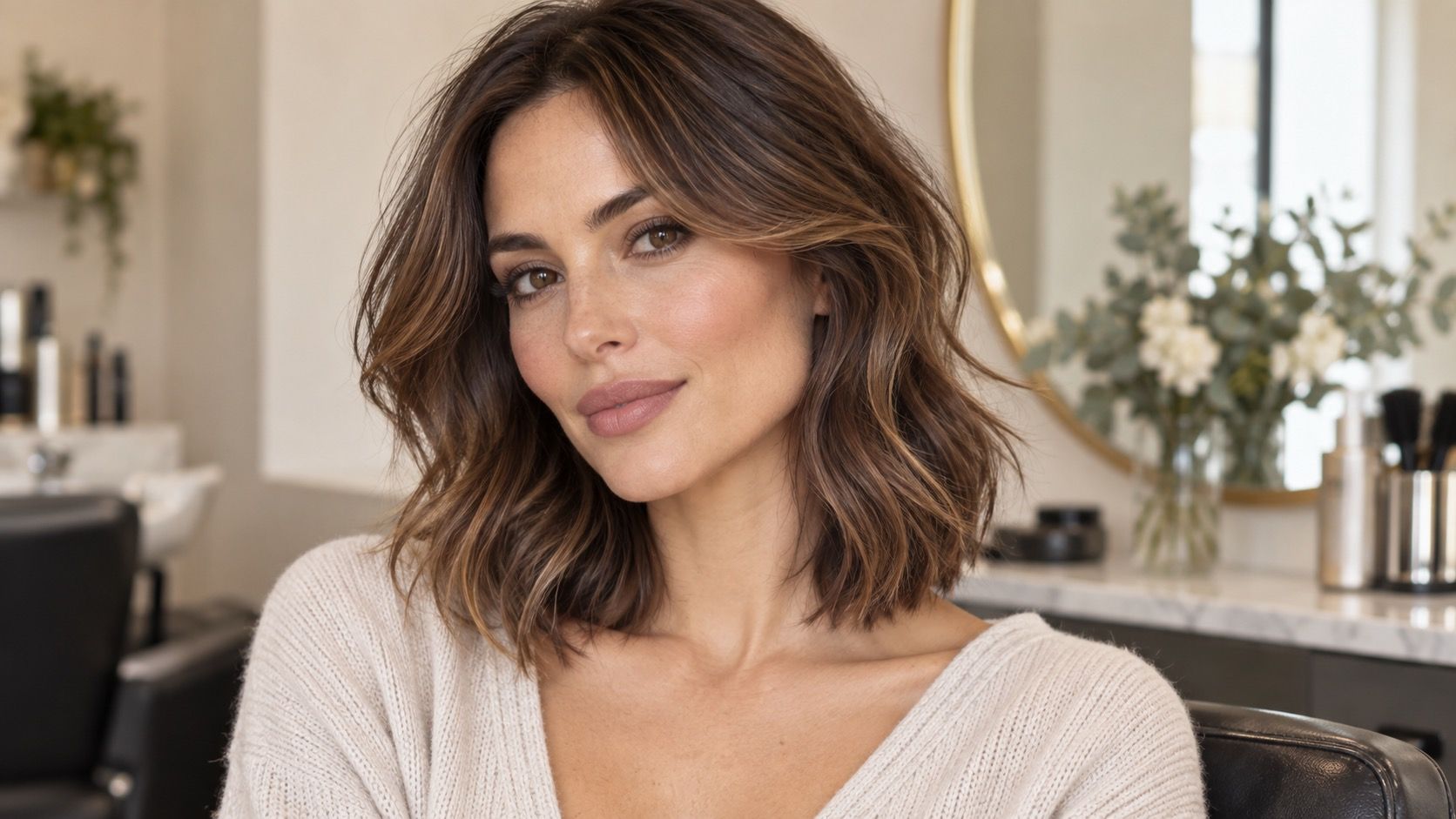
A square face is often described as strong or striking, which is fair but not very useful when you are standing in front of a mirror deciding whether to cut bangs or buy new glasses. The useful question is simpler: where does your face carry its width, and which styling choices make you feel most like yourself? A square face shape usually has a broad forehead, full cheek area, and a defined jawline of similar width. That outline gives you plenty to work with; it does not require hiding or correcting.
Check the outline before you label your face
Pull your hair back, use even daylight, and look at the whole perimeter rather than one feature. With a square face, the forehead, cheekbones, and jaw often read as nearly equal across. The jaw is the clue people notice most: it tends to turn outward toward the corners instead of narrowing steadily toward the chin. A round face can also look wide, but its jawline is softer. A rectangle face can have the same jaw, but is visibly longer from hairline to chin.
Take a straight-on photo at arm's length rather than judging through a close phone camera. Wide-angle lenses enlarge the centre of the face and can make any jaw seem broader. Mark the width at the forehead, cheekbones, and jaw with your fingers or a washable mirror pencil. Measurements do not need to match perfectly. A face has movement, asymmetry, and flesh over bone; the goal is to notice the dominant pattern, not pass an exam.
It is also worth separating a naturally defined jaw from temporary puffiness, a beard outline, or a haircut that ends exactly at the jaw corners. Those can change the impression dramatically. If your forehead is much narrower than your jaw, triangle may be a better starting point. If your cheekbones are clearly widest and both forehead and chin taper away, look at diamond instead. Getting this first step roughly right saves a lot of bad styling advice later.
Choose haircuts by the effect you want
The best haircut for a square face is not one universal cut. Soft layers, a loose bend, and slightly uneven texture often make the outline feel less geometric when that is the effect you want. A collarbone-length cut with face-framing pieces works because it creates vertical movement beside the jaw rather than stopping in a blunt horizontal line. Ask for layers that begin below the cheekbone if you want the sides to feel lighter.
A blunt bob can look excellent too, especially if you enjoy a graphic, deliberate finish. The difference is placement. A bob that lands at the widest part of the jaw can emphasize the corners; one that finishes just below the jaw or has a subtle inward curve usually feels more balanced. Bring a photo of the length and texture you actually want. The word soft means something different to every stylist, while a reference shows whether you mean airy waves, rounded ends, or simply less bulk.
For short hair, a textured pixie, a cropped shag, or a side-swept crop can keep the silhouette lively. Very severe micro-bangs paired with a sharply squared bob create a strong fashion look, but they double down on angles. That is not wrong; it is a choice. If you are uncertain, keep one element relaxed: a curved fringe, feathered crown, or softly broken-up ends.
Use bangs and partings as small adjustments
A side part is popular for square faces because it interrupts a symmetrical outline and lets hair cross the forehead on a diagonal. It is a low-risk change: try it on clean, dry hair for a few days before treating it as a rule. A centre part can be just as flattering when the hair has volume at the crown or softness around the cheeks. Flat, poker-straight hair with a dead-centre part tends to show every edge more clearly, which some people love and others do not.
Long curtain bangs are an easy middle ground. They can open around the eyes, taper toward the cheekbones, and avoid making a firm horizontal line across the forehead. A side-swept fringe does a similar job, especially on hair that naturally bends. Keep in mind that bangs are a maintenance decision, not just a face-shape decision: humidity, cowlicks, glasses, and a five-minute morning routine matter more than a chart.
If you have a broad forehead and prefer coverage, ask for a fringe with separated pieces rather than a dense, ruler-straight block. The small gaps keep it from feeling helmet-like. If your hair is fine, avoid piling too much fringe forward; losing density around the temples can make the sides look flat. A trim appointment is the sensible place to test this, not the night before an event.
Frames and earrings can change the visual rhythm
Glasses sit in the most visible part of the face, so their shape matters more than a trendy label. Rounded rectangles, oval frames, soft cat-eye shapes, and frames with a gentle upsweep often contrast nicely with a defined jawline. The key practical check is width: the frame should roughly follow the width of your face at the temples without extending far beyond it. A frame that is too narrow can make the jaw look wider by comparison.
Angular frames are not forbidden on a square face. They can look sharp and intentional, particularly with a thin rim or rounded corners. What often feels heavy is stacking a very boxy, thick black frame over a strong brow and an equally strong jaw. Try the same frame in a lighter tortoiseshell, translucent acetate, or a slimmer metal before deciding that the shape itself is the problem. Sunglasses deserve the same test outdoors, where a dark lens changes the balance.
For earrings, hoops, drops, oval shapes, and curved designs add movement beside the jaw. Small square studs can be chic but may disappear in a bold haircut. If you wear statement earrings, look at them with your usual collar and hairstyle, not only in a jewellery-store mirror. The neckline, hair volume, and frame choice work together more than most face-shape lists admit.
Makeup and facial hair: define selectively
Makeup on a square face works best when it follows your preference rather than an old instruction to erase angles. If you enjoy contour, place it lightly beneath the cheekbone and blend upward, then soften the transition at the temples. A hard dark stripe along both sides of the jaw usually reads as makeup before it reads as sculpting. Cream products and a damp brush make it easier to stop before the effect becomes theatrical in daylight.
Blush placement can subtly shift the mood. Sweeping it from the apple of the cheek toward the temple creates lift; keeping it centred gives a fresher, rounder look. Neither is mandatory. A little glow on the upper cheekbone can catch light beautifully, but very reflective highlighter across a textured area may emphasize texture in close photographs. Test the finish by a window and with your phone's rear camera, not only under bathroom lighting.
For facial hair, a short beard with softened corners or a little length at the chin can change the outline without concealing it. The trap is carving an extremely square beard line that sits wider than the natural jaw. Ask a barber to keep the cheek line natural and to assess the beard from straight on as well as profile. A moustache, light stubble, or clean shave can all work; density and maintenance are more important than forcing a particular silhouette.
A quick comparison when a choice feels close
| If you notice | Try first | Watch for |
|---|---|---|
| Jaw and forehead look similarly wide | Soft layers or a side part | Ending a blunt cut at the jaw corners |
| You like a clean, graphic look | Structured bob or angular frames | Adding heavy bangs and thick square frames at once |
| Your hair is fine or flat | Lift at the crown and separated fringe pieces | Removing too much density around the temples |
| You wear glasses daily | Oval or gently upswept frames in the right width | Choosing by online photos without checking temple fit |
The most reliable approach is to change one variable at a time. Try the parting before the cut, the frame before a new makeup routine, or a longer beard setting before reshaping its outline. Square face features are not a problem to solve. They are a clear foundation, and the flattering choices are the ones that support the level of softness, structure, or drama you actually want to see.