A face shape guide is best treated like a map with broad regions, not a customs desk that demands one exact answer. Most people can recognise a familiar outline in a mirror, yet hesitate between two names once they start comparing photos. That hesitation is normal. Face shape comes from the way the forehead, cheekbones, jawline, and length work together, while hair, expression, and camera angle keep changing the view. The useful part is learning to see those relationships without turning them into restrictions.
Look at the outside edge before the features
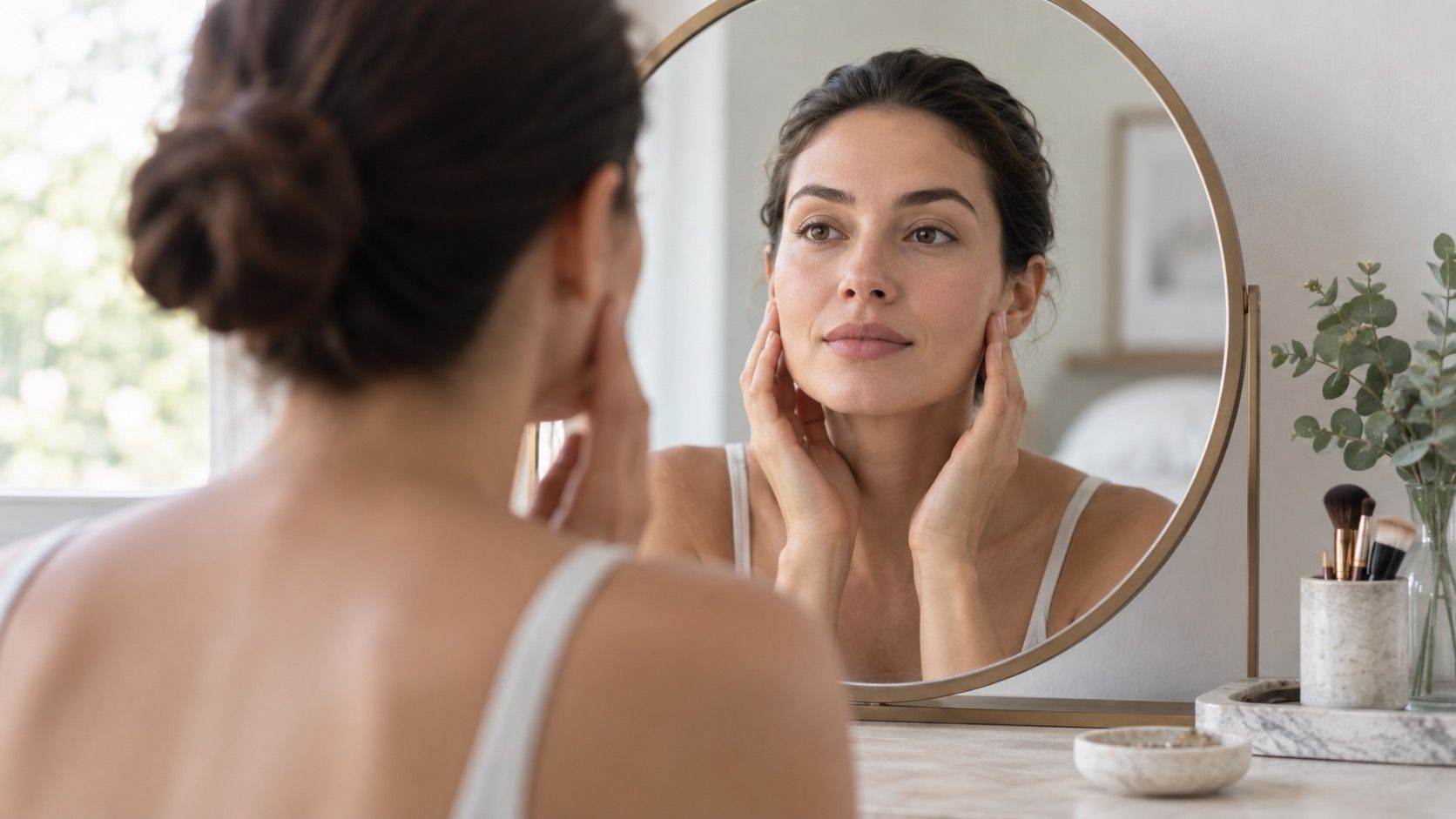
Start with the face pulled clear of hair, in a front-facing mirror or a photo taken at eye level. Let your eye travel from the hairline to the temple, over the cheekbone, along the jaw, and down to the chin. This route gives a truer impression than staring at your nose or brows. A face can have striking eyes and still have a very soft outer contour; it can have a delicate mouth and a noticeably angular jaw. The outline is what the categories describe.
There are three questions worth asking. Is the face longer than it is wide, or close to equal? Where is its broadest point: forehead, cheeks, or jaw? Does the lower edge narrow, curve, or turn in a firm corner? You do not need perfect measurements to answer them, although a soft tape can make a close call clearer. A few millimetres matter less than the pattern you see in normal light.
Hair can disguise the route. A full fringe brings attention to the upper third, while hair piled high lengthens the silhouette. Remove glasses and heavy contour for the first look if you can. Then put your everyday styling back and notice how it edits the outline. That second observation is often the one that helps with a haircut or frames.
Oval and round faces can share softness but not proportion
An oval face usually reads as gently longer than wide. The forehead may be slightly wider than the jaw, the cheekbones sit near the widest point, and the chin rounds without looking tiny. There are no strict mathematical rules behind it. The key impression is balance: the sides taper quietly, and no single section dominates. An oval face may still have a high forehead, full cheeks, or a defined chin.
A round face has soft edges too, but its width and length feel closer. The cheeks often create the broadest area, and the jaw turns toward the chin without a hard angle. It is easy to mistake a round face for oval in a photo taken from above, because that angle adds apparent length. A level mirror check usually clarifies whether the vertical line really leads or whether the face has a compact, circular rhythm.
| Shape | First visual clue | Useful cross-check |
|---|---|---|
| Oval | Length gently exceeds width | Jaw is narrower and softly rounded |
| Round | Cheeks and width are prominent | Length and width feel relatively close |
| Square | Jaw and forehead appear similarly broad | Lower corners read clearly |
| Heart | Upper face opens wider than chin | Outline tapers downward |
Neither description predicts what will suit you. It simply gives language for contrast. Someone with a round face may enjoy a sharp rectangular frame; someone oval may prefer an oversized round pair. The point is to understand whether the frame repeats the face’s softness or deliberately interrupts it.
Square, rectangle, and oblong faces need a length check
A square face often has a forehead, cheek area, and jaw that appear similar in width. The signature is not merely a short face; it is the sense of structure at the jaw. Look for a visible turn beneath the ears and a lower edge that travels more horizontally before the chin. Soft tissue, age, and facial hair can blur that corner, so compare several views rather than expecting a drawn square.
Rectangle and oblong faces carry more length. The terms are often used interchangeably, though rectangle usually suggests a more angular jaw and relatively parallel sides, while oblong suggests a longer, softer version. In both, the middle and lower face seem extended compared with the width. A high forehead alone does not create an oblong shape; the length needs to continue through the cheeks and jaw.
This distinction matters when you are deciding on visual balance. A long, angular face and a long, soft face may respond differently to the same blunt fringe or narrow frame. Rather than memorising bans, ask what a styling choice adds: width at the temples, height at the crown, curve near the jaw, or a clean horizontal line.
Heart, diamond, and triangle shapes change where width lives
A heart face is usually broader through the forehead or upper cheek area and narrows toward a smaller chin. The hairline may form a gentle peak, but it does not have to. What matters is the downward taper. A side part can make this feature look more pronounced, while a full fringe can make the upper face appear more compact. Treat those as styling effects, not corrections.
A diamond face is widest at the cheekbones, with both forehead and jaw looking narrower. The temples may taper inward, and the chin can be pointed or softly rounded. This shape is often missed because people focus on the chin and call it heart-shaped. Check the upper forehead: if the cheekbones clearly lead the width rather than the forehead, diamond is the more useful comparison.
Triangle or pear proportions reverse the heart pattern. The forehead is relatively narrow and the jaw appears stronger or wider. A beard, jaw-length bob, or strong lower-frame glasses can emphasise this, which may be exactly the effect someone wants. The category says where the emphasis starts; it says nothing about whether the emphasis is good or bad.
Use categories as a styling vocabulary
The types of face shapes are descriptive shortcuts. They help a stylist understand “wide cheekbones, soft jaw, slightly long face” without needing to see you immediately. They can also make shopping less random: before trying frames, decide whether you want to echo your outline, add angles, add width, or keep the centre of the face open. That is a far better question than asking which shape is permitted to wear one trend.
When two labels fit, keep both. An oval-diamond face, a soft square, or a long heart-shaped face is a normal human observation, not an error in the guide. Recheck in neutral light, use measurements only to support what you see, and choose the descriptions that explain your features most clearly. Your final test is always the mirror in the conditions where you will actually wear the look.
A face shape can be a useful starting point for hair, glasses, makeup, and grooming. It should never become a rulebook that makes you abandon something you like. The best result is simple: you know what your proportions do visually, and you have a few intelligent ways to play with them.