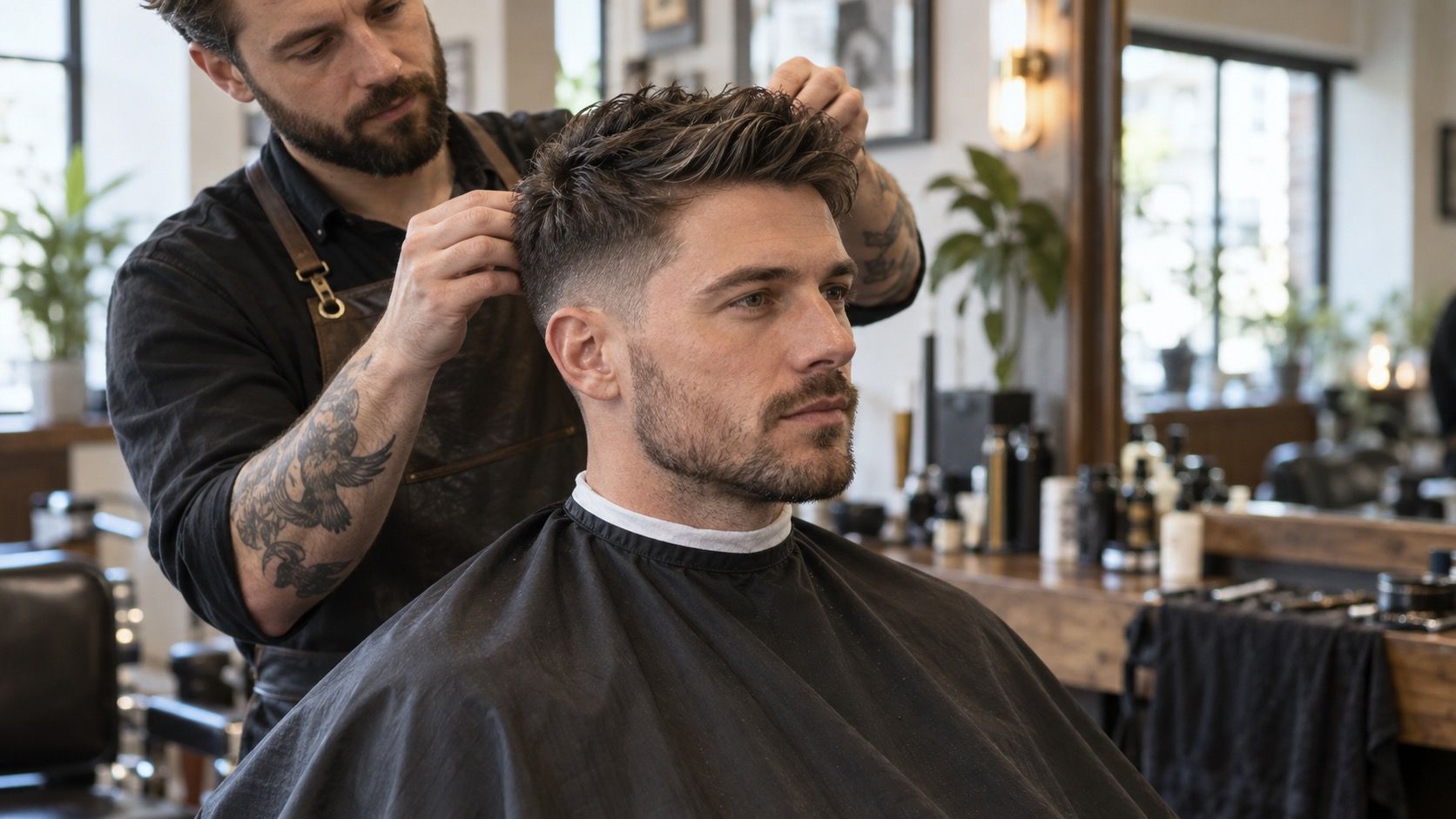
Men's hairstyles for face shape are often reduced to a few blunt commands: add height to a round face, keep an oval face short, hide a receding hairline. Real barber chairs are less tidy. The right cut has to work with the direction your hair grows, how quickly the sides puff out, whether you wear a beard, and how much product you will use before work. Face shape gives the cut a starting proportion, not a uniform to wear.
Look at the face, hairline, and crown before naming a haircut
Start in clear daylight with dry hair pushed back gently. Compare forehead width, cheekbone width, jaw width, and overall length. A round face tends to have soft corners and similar length and width. A square face has a clearer jaw and often a broad forehead. An oblong face reads longer from forehead to chin. Oval faces are usually balanced but can still look longer if the top is pushed very high. A triangular or heart-shaped outline may be widest at the jaw or forehead respectively.
Then check the parts most haircut charts ignore. A mature hairline, temple recession, a double crown, and a stubborn cowlick can make a neat reference photo impossible to copy. Hold the phone at eye level rather than under the chin; low-angle photos exaggerate the jaw, while close selfies widen the nose and middle of the face. A barber can work with a changing hairline far better when it is discussed openly before the clipper reaches the temples.
Balance top length against the sides, not against a trend
The top-to-side ratio does much of the visual work. A close fade with a tall quiff creates strong vertical contrast. That can sharpen a rounder face, but on a naturally long face it may add length that was not needed. Leaving more width at the sides can steady an oblong outline, especially when the top has textured rather than vertical volume. A square face often suits both short and medium cuts; the decision is whether you want to emphasize the jaw with clean edges or soften it with texture.
Do not treat a fade as a universal upgrade. A skin fade grows out quickly, exposes the temple area, and can make fine hair look thinner between appointments. A low taper keeps a little density around the ears and is easier to live with if visits are every three or four weeks rather than every ten days. Ask the barber where the blend will sit when it grows out. The answer matters more than the name of the fade.
| Face impression | Cut direction to try | Practical warning |
|---|---|---|
| Round or soft outline | Textured top with measured height; sides kept neat but not necessarily bare | Too much height plus a very high fade can look disconnected |
| Long or oblong outline | Moderate top, a fringe or forward texture, and some side width | A tall pompadour can lengthen the face further |
| Strong square jaw | Crop, side part, or relaxed texture with a softer blend | Very hard line-ups make every angle more severe |
| Wider forehead and narrower chin | Forward fringe or balanced side part with restrained crown volume | High volume can overemphasize the upper face |
Use fringe, texture, and parting to solve a specific problem
A fringe is useful when it is chosen for a reason. A short textured crop can break up a broad forehead and make thin front hair look less exposed than a swept-back style. A longer fringe can soften a long face, but only if the hair naturally falls forward; fighting a cowlick with heavy paste is a daily argument you will eventually lose. If the forehead is a feature you like, there is no need to cover it simply because a chart suggests it.
Texture works best when it matches the strand. Matte clay gives short, dense hair separation and hold, while sea-salt spray may add grip to fine hair before blow-drying. Thick, coarse hair can become helmet-like with too much product, especially in a clean side part. Use a fingertip amount first, then look from the side. The best haircut for men face shape should remain legible after a windy commute, not only under a barber's ring light.
Coordinate the beard with the haircut and jaw
A beard changes the lower third of the face, so it can either support or undo the haircut's proportions. If a face feels round, keeping the cheeks tidy and leaving slightly more length at the chin can add definition without making a pointed cartoon beard. On a long face, a very long chin beard often extends the outline; a fuller but shorter shape at the sides may feel more balanced. A square jaw may look excellent with light stubble or a softly rounded beard line if you want less angularity.
Check the beard from a normal conversational distance. A sharply carved cheek line can look smart in a close mirror but artificial in a phone photo. The neckline should usually sit above the Adam's apple rather than climbing onto the jaw. Bring the beard into the same appointment when possible: the transition from sideburn to fade is where a deliberate men's face shape haircut begins to look coherent.
Tell the barber what happens after the first week
Useful barber language is concrete. Say, “I want the crown to lie down,” “the fringe must not fall in my eyes,” or “the sides become wide after two weeks.” Show one photo for the shape and another for the finish; a polished red-carpet style and a low-maintenance crop can share a name while requiring completely different work. Mention whether you wear a helmet, cap, glasses, or headphones. Those details change the sensible length around the ears and temple.
Ask for a small adjustment before a dramatic one. If you are testing a crop after years of medium hair, leave enough fringe to shorten later. If you have never worn a fade, start lower rather than taking the blend to the crown. Most good cuts improve after the first wash, when the barber's styling product disappears and your growth pattern takes over.
Judge the haircut in your own mirror and schedule
Give a new cut a week. Wash it, style it once in a hurry, and look at it under office lights and outdoors. If it feels wrong, note the exact point: a heavy corner above the ear, too much weight at the crown, a fringe that separates, or a beard line that makes the chin look longer. These are fixable details. “My face shape cannot wear this” is rarely precise enough to help.
The most convincing choice is often quiet: it respects the hairline, has a shape after two weeks, and does not need ten minutes of product. That is a better test than whether it has the right label on a men's hairstyle chart.