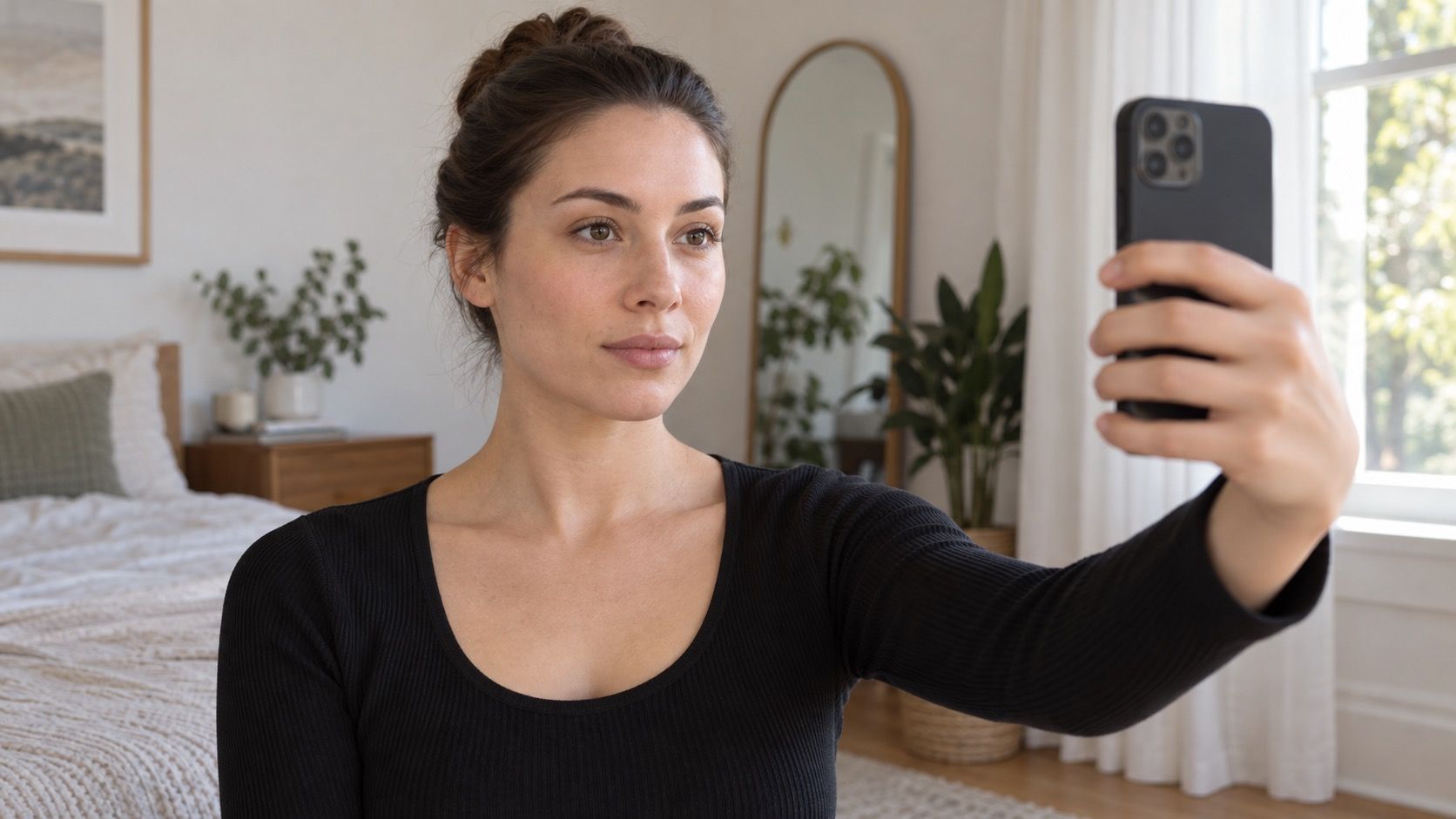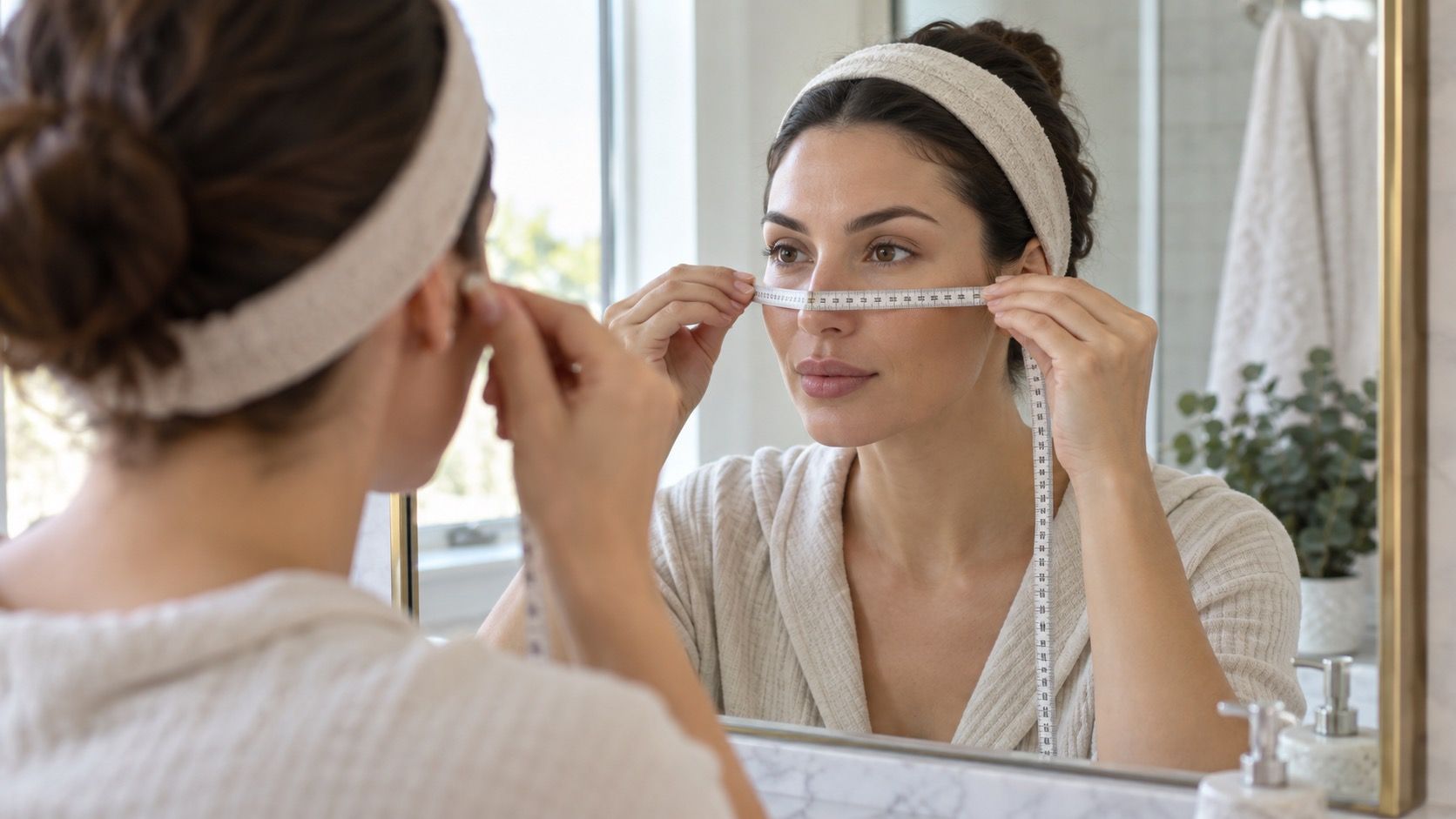
Learning how to measure face shape does not require a beauty counter, a complicated app, or a perfectly symmetrical face. A soft tape measure, decent light, and five quiet minutes are enough. The aim is not to collect impressive numbers. It is to see where your face is widest, how its length compares with its width, and whether the lower edge is soft, tapered, or angular. Those observations are more dependable than the result of a hurried selfie.
Set up the mirror before you measure
Choose a mirror that lets you stand straight at arm’s length. A window-facing spot in the daytime works well; overhead light can throw a shadow under the cheekbones and exaggerate the jaw. Pull hair back from the forehead and temples with a loose band. Leave the natural hairline visible, but avoid a tight style that shifts it upward. Remove glasses for the first measurement because frame width can distract your eye from the real edge of the face.
Keep your chin level and relax your mouth. Looking up extends the neck and makes face length seem greater; looking down compresses the lower third. It is tempting to suck in the cheeks or set the jaw when you are concentrating. Resist it. You are measuring your ordinary resting face, the one visible in conversation or in a passport-style photo, not a deliberate pose.
If a mirror feels awkward, take a front-facing photo from several feet away with the camera level with your eyes. Do not use portrait distortion or a wide lens. Mark no lines on your skin; simply make a note of the points you used. Repeating the process later is valuable, because a single measurement can be nudged by a slippery tape or an uncertain hairline.
Take face length and forehead width first
For face length, place one end of the tape at the centre of the natural hairline and let it run straight down to the lowest point of the chin. Record the number in centimetres or inches; the unit is irrelevant as long as you use the same one throughout. If your hairline is uneven, use the visual midpoint rather than the deepest corner. The goal is a fair central line, not a forensic answer.
Measure forehead width across the broadest part, usually between the outer edges of the hairline above the brows. Do not measure from temple to temple if the temples sit much wider or narrower than the upper forehead. Look in the mirror while holding the tape lightly and keep it horizontal. A forehead can be broad without making the whole face heart-shaped, so save the conclusion until the other measurements are in place.
A practical note: write the numbers immediately in a notes app. Face shape measurements blend together surprisingly fast. Add a short description beside each one, such as “forehead slightly wider than jaw” or “hairline curved.” That language will be useful when the numbers are close and you need to compare the outline rather than hunt for a mathematical label.
Find the cheekbone and jaw measurements
Cheekbone width is the distance between the fullest outer points of your cheekbones. These points are not always directly beneath the outer corners of the eyes. Feel gently along the upper cheek if needed, then look for the widest horizontal span in the mirror. Keep the tape straight across the front of the face rather than wrapping it around the curve. A curved tape gives a larger number that cannot be compared with face length.
Jaw width is often the trickiest line. Measure from the centre of the chin to the point where the jaw turns upward beneath one ear, then double that result. Use the visible corner if your jaw is angular; for a softer jaw, use the point where the lower edge starts rising toward the ear. It is an approximation, and that is fine. The useful question is whether the jaw looks meaningfully narrower, similar to, or broader than the forehead and cheekbones.
| Measurement | Start and finish | Check before recording |
|---|---|---|
| Face length | Hairline midpoint to chin | Chin level; tape straight |
| Forehead width | Widest visible upper forehead | Hair pinned back naturally |
| Cheekbone width | Fullest outer cheek points | Do not wrap tape around cheeks |
| Jaw width | Chin to jaw corner, then double | Use the same side each time |
It can help to take each measurement twice. If the difference is substantial, do a third and use the middle result. This is not because your face is changing by the minute; it is because the tape and hand position introduce small errors. Consistency beats precision theatre.
Turn the numbers into an outline
Now compare proportions rather than searching for an exact ratio. If face length is noticeably greater than width and the jaw curves gently, you may read as oval or oblong depending on how long the sides appear. If cheekbone width and face length are close, with a rounded jaw and forehead, round may be a useful description. A square face can also be close in width and length, but it usually has a clearer corner at the jaw and more parallel sides.
A wider forehead narrowing toward a small chin often suggests heart features. Cheekbones that stand out as the widest point, with a narrower forehead and jaw, can suggest diamond features. A strong jaw that is widest at the lower face may point toward triangle or pear proportions. These categories overlap. A face can have an oval overall length and a heart-like upper third without needing to choose one identity forever.
Use the mirror to settle close calls. Numbers cannot tell you whether a jawline appears soft in ordinary light, and that visual fact affects glasses and hairstyles more than a tiny difference in centimetres. Draw an imaginary line around the outside of the face. Where does it widen? Where does it narrow? The answers make your written measurements intelligible.
Errors that make a good measurement misleading
The biggest error is using a close phone camera as though it were a mirror. At arm’s length, the lens can enlarge the central face and alter the apparent width of the jaw and forehead. Another common mistake is measuring over hair, thick sideburns, or a beard and treating that as bone structure. Hair and grooming are important for styling, but measure the face beneath them first, then consider their effect separately.
Do not compare your numbers with someone else’s chart. Different hairlines, facial structures, and tape positions make that a frustrating exercise. Compare only the four values from your own session. If one side of your face is visibly fuller, measure the visual centre rather than trying to force both sides to agree. Normal asymmetry does not invalidate the result.
Finally, do not let a label make decisions for you. Find your face shape, then test a frame, parting, or haircut in a mirror. A measurement gives you a useful starting map; personal style, hair texture, and comfort decide what you want to do with it.