A face shape test is most useful when it replaces guessing with a calm look at proportion. I have seen people decide they are round after one selfie, then change their mind after pulling their hair back. Both reactions are understandable: lenses, a smile, and a high ponytail can alter the outline. This check is not a verdict. It is a repeatable way to notice the relationship between your forehead, cheekbones, jawline, and face length before you choose a haircut, frames, or makeup placement.
Start when your face looks like itself
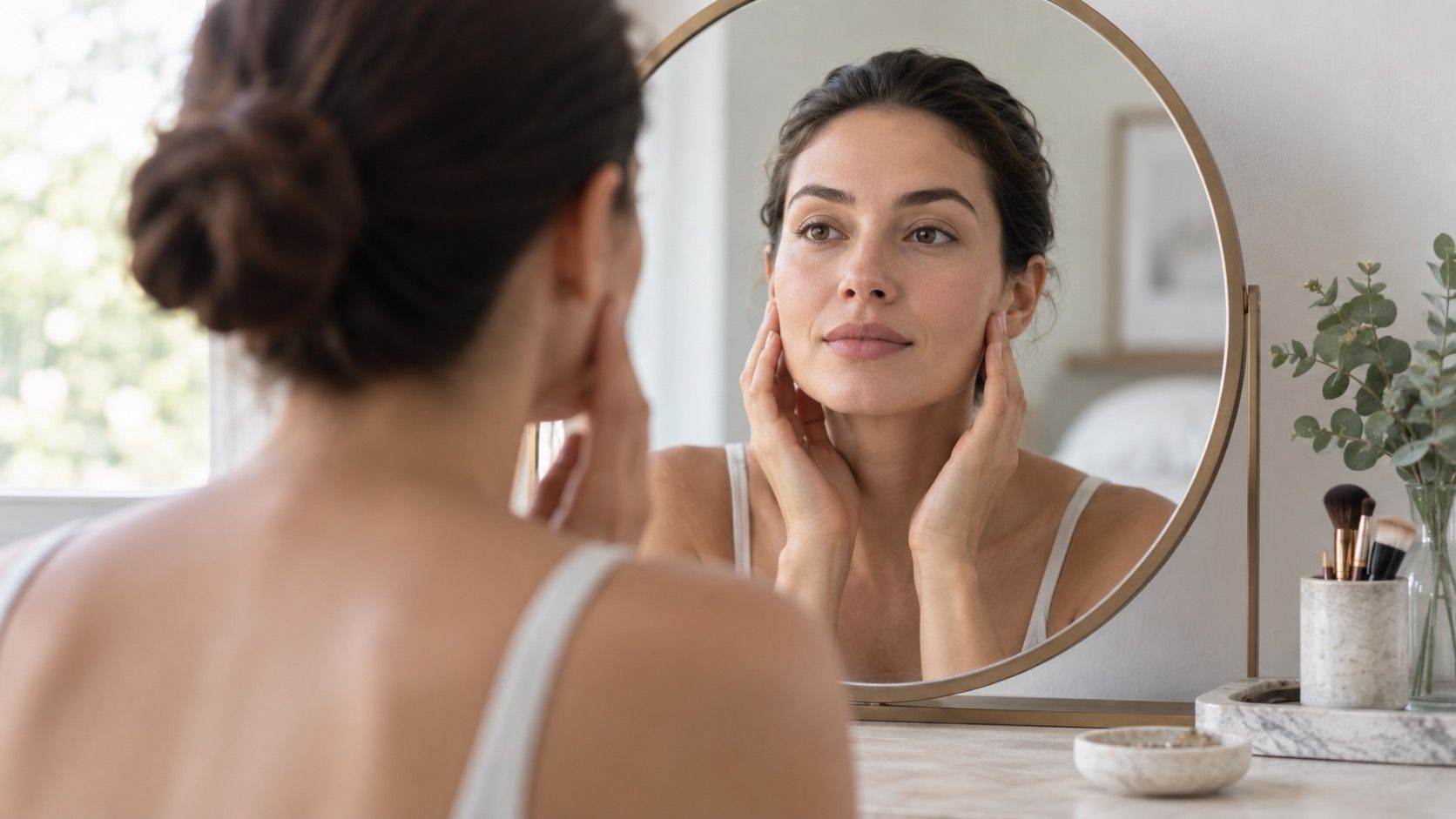
Use a well-lit mirror or a front-facing photo taken at eye level. Daylight near a window is kinder and more honest than a bathroom spotlight, which often deepens one side of the face and makes a soft jawline look sharper than it is. Tie hair away from the temples and forehead, but do not pull it so tightly that the natural hairline shifts. If you normally wear a fringe, pin it back for the test and then remember that it is part of your everyday look when you later choose a style.
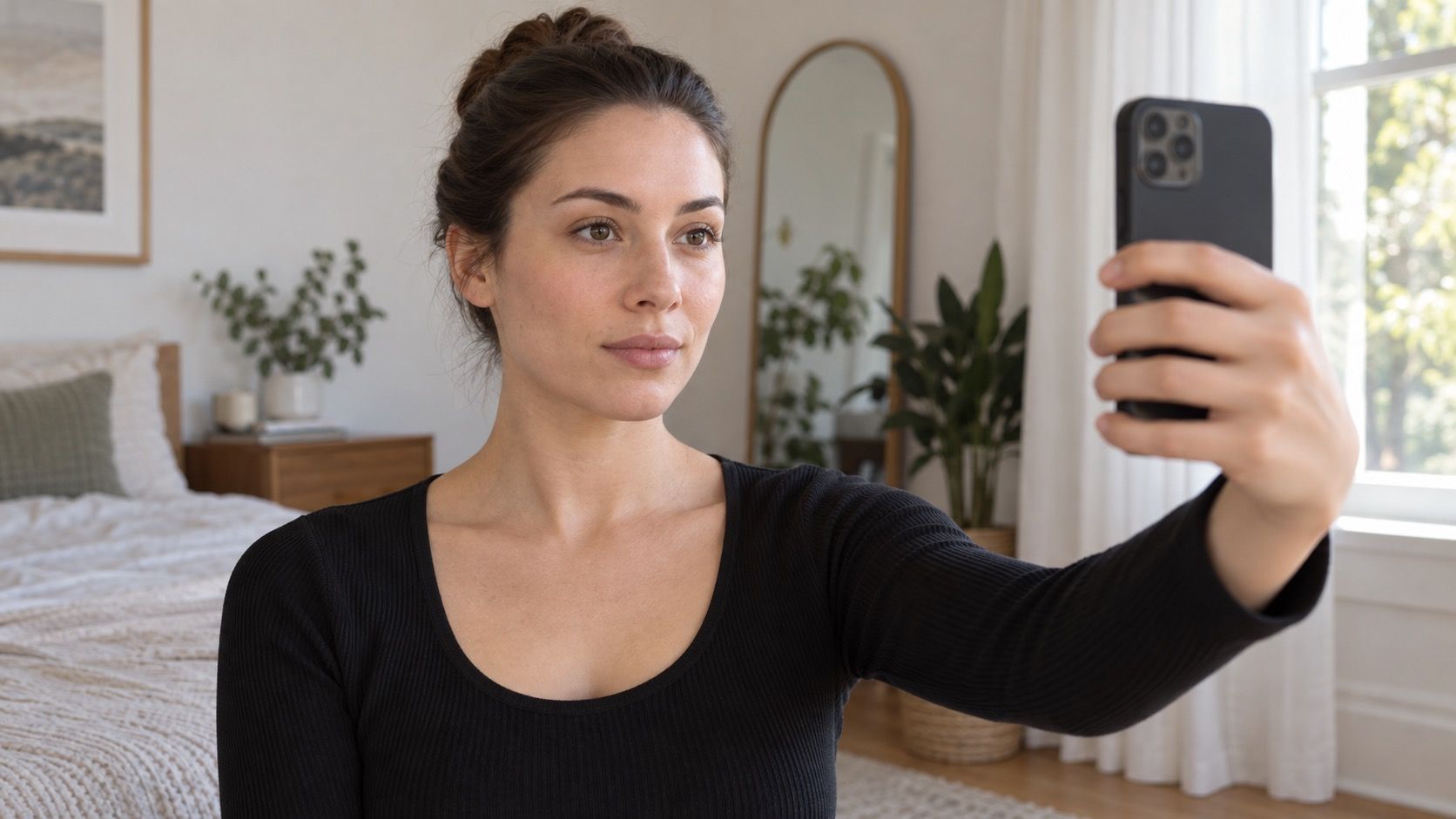
Keep your expression neutral. A broad smile can lift the cheeks and widen the lower half of the face; a tilted chin adds length. Stand far enough from the mirror to see the whole outline rather than studying one feature at a time. With a phone, use the rear camera if practical, step back, and avoid the wide-angle setting. The common close selfie is useful for checking makeup, but it is a poor starting point for the question, what is my face shape?
Do the mirror check twice, ideally on different days. Skin puffiness, hair volume, and even the way you hold your shoulders can make one result feel more dramatic. A reliable result usually has a pattern that survives these small changes. If the first check says oval and the second says slightly oblong, that is not a failed face shape quiz; it is useful information about a face that sits between familiar labels.
Measure four areas instead of chasing one label
A soft tape measure helps, though a ruler held loosely in front of the mirror can give a rough comparison. Measure face length from the midpoint of the hairline to the bottom of the chin. Then compare the forehead at its broadest useful point, usually a little above the brows; the cheekbones across their widest point; and the jaw from chin to just below one ear, doubled for an approximate full width. Write the numbers down before memory smooths out the differences.
Do not press the tape into the skin or curve it around the face. You want straight, front-view distances, not the circumference. If one cheekbone is a little higher or one side of the jaw more pronounced, measure the overall line rather than trying to correct yourself into perfect symmetry. Nearly everyone has a stronger side. The test is about the outline a friend sees from across a table, not an architectural drawing.
| Area | Where to check | What it can suggest |
|---|---|---|
| Face length | Hairline midpoint to chin | Whether the face reads compact or elongated |
| Forehead | Widest natural line above brows | A broader or narrower upper third |
| Cheekbones | Outer cheek to outer cheek | Where the face reaches its widest point |
| Jawline | Jaw corner through the chin | Soft, tapered, or angular lower shape |
Numbers are a prompt to look again, not a formula that assigns a personality or attractiveness score. A few millimetres rarely matter. What matters is whether the width sits mostly at the cheeks, at the forehead, or along a strong jaw, and whether the sides travel in a smooth curve or in clear angles.
Read the outline in the right order
First look at length versus width. An oval face often appears longer than it is wide, with the cheekbones gently wider than the jaw. A round face has a closer width-to-length ratio and soft, continuous sides. A square face can have similar overall dimensions too, but its forehead and jaw read more parallel and the jaw corners make the difference. This is why a single measurement cannot settle the question.
Next follow the route from hairline to chin. A heart face often begins with a more open forehead and narrows to a smaller chin. A diamond face is widest at the cheekbones, while its forehead and jaw look narrower by comparison. An oblong or rectangle face usually carries length through the middle and down the jaw, rather than simply having a high forehead. Watch the outer edge, not just the central features: brows, lips, and nose can distract from the actual silhouette.
I find it helpful to trace the outline in the air with a finger. Pause at the broadest point, then at the sharpest turn. If there is no obvious turn at the jaw, call it soft; if the line changes direction near the ears, call it angular. These ordinary observations are often more useful than arguing over whether a face is exactly oval or a little long.
When two face shapes both seem plausible
Many faces honestly have a primary shape and a secondary tendency. Someone may have an oval length with a heart-shaped forehead, or a round cheek area with a jaw that is more square in profile. Age, weight change, facial hair, and haircut can shift what the outline emphasizes. Instead of forcing a perfect match, describe two facts: where the face is widest and how the jaw finishes. That description gives better styling guidance than a rigid category.
Photos need a special caution. A camera held below eye level makes the jaw larger; a camera above the face enlarges the forehead and shortens the chin. Compare a straight-on image with the mirror, not with a filtered portrait. If glasses are already on your face, remove them for the basic test, then put them back on and notice what they visually add. Thick rectangular frames can make a soft face look more structured, while round frames can echo curved features.
For a haircut consultation, bring the conclusion as a short note rather than a declaration: “My cheekbones are the widest point, my jaw is soft, and my face is a little longer than wide.” A good stylist can work with that. It leaves room for hair density, curl pattern, and the time you actually want to spend styling each morning.
Use the result for choices, not restrictions
Once you have a likely face shape, test styling ideas as visual balance. If you want more definition, an angular frame, a side part, or a little height at the crown may create it. If you want softness, rounded layers or a gentler brow shape may do the opposite. None of these is a rule that says certain people may not wear certain things. The mirror is the final check, especially in the lighting where you live and work.
Try one change at a time. A new fringe, bold glasses, and heavy contour on the same day make it impossible to know what you actually like. Take a front photo in neutral light, then look again after several hours rather than deciding in the shop. The most convincing face shape test result is the one that helps you explain why a look feels balanced to you, not the one that wins a debate online.
Your face also does not need correcting. Categories are simply a shared vocabulary for proportion. Use them when they make a decision easier, ignore them when they make you second-guess a style you enjoy, and revisit the mirror check whenever a different haircut or pair of frames changes the picture.